Flight delay confirmation: how to get it from the airline
A written delay confirmation can secure up to €600 per passenger. We help you get it, and we check your eligibility for free, €0 upfront.
A flight delay confirmation is a written statement in which the airline officially acknowledges the delay: how long it lasted, what caused it, and above all the actual arrival time. You need it to justify an absence from work or school, to trigger travel insurance, to build a compensation claim, or to claim consequential loss under the Montreal Convention.
But the best confirmation letter will never replace what only you can do in the moment. Let us start there.
Three things to do before you leave the airport
These take thirty seconds, and they often carry more weight than the confirmation letter the airline sends you weeks later. Nobody at the desk will tell you about them.
1. Photograph the departure board
The moment Delayed, Cancelled or Diverted appears, take a picture.
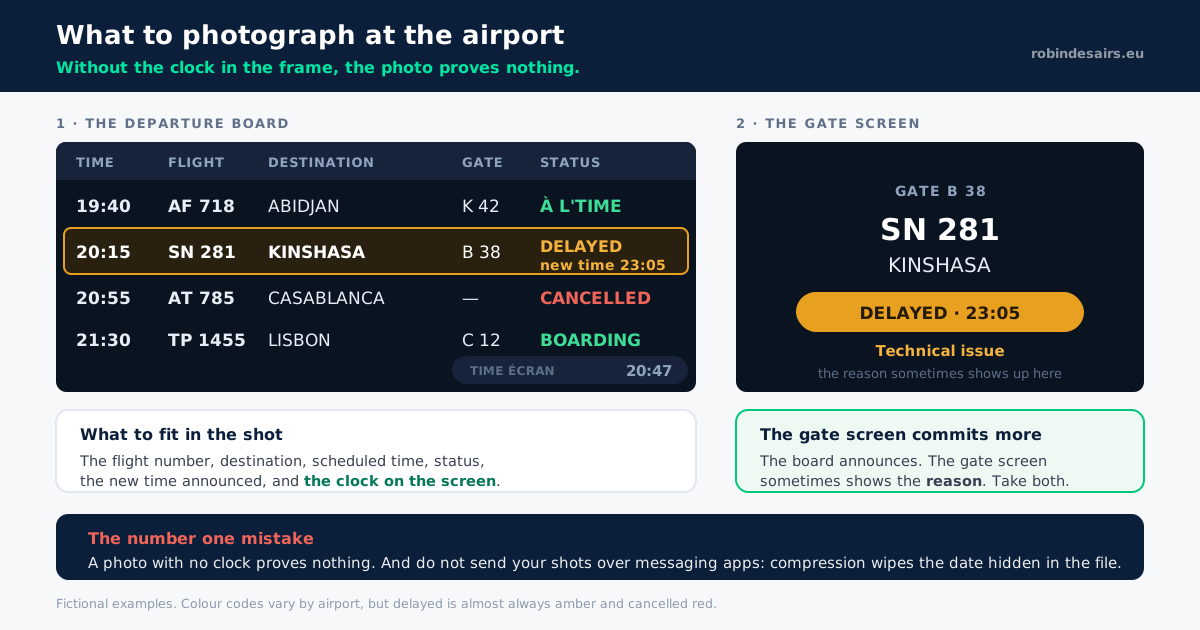
Photograph both screens, not just one. The departure board announces. The gate screen commits further: that is often where a reason appears, such as a technical issue or a late inbound aircraft.
That reason matters enormously. It is often the only place where the airline puts something in writing, on the spot, before its legal department reformulates. An airline that displayed “technical problem” at the airport will struggle to invoke extraordinary circumstances later.
The number one mistake, and it is fatal: photographing without the time. A screen reading “Delayed”, with no clock and no date, proves nothing at all. Frame the clock on the screen, or make sure your phone stamps the shot.
And do not send those photos over messaging apps before backing them up. Compression strips the file metadata, precisely the part carrying the date and time. Send the originals.
2. Write down the reason announced out loud
If a reason is given over the PA, in the gate area or in the cabin, write it down word for word with the time of the announcement. A note on your phone is enough.
A spoken announcement carries no formal weight. But set against the written version supplied months later, it exposes contradictions, and that is often where a claim is won.
3. Note the exact time the door opened
This is the most important step, and the least known.
The delay is not measured at touchdown. It is measured at the moment the aircraft door opens and you can get off. The Court of Justice of the European Union settled this in Germanwings v Henning.
Ten to twenty minutes routinely pass between wheels on the ground and an open door. On a flight that landed 2h50 late, those minutes decide whether you receive €600 or nothing.
Why the gap widens exactly when it matters
At a large airport such as Paris-Charles de Gaulle, fifteen minutes between touchdown and an open door is a minimum, and it is often more. The taxi from runway to stand can be very long. The jet bridge then has to dock, or steps have to be brought up and secured. Each step needs a ground crew that is there, available, in the right place.
And here is an effect few passengers are aware of: it is precisely because your flight is late that the wait at the door gets longer.
Ground crews plan their day around scheduled times. An aircraft turning up two or three hours out of sync arrives when that crew is elsewhere, on another aircraft, or already gone home. At night the effect is brutal: a flight due in the evening that touches down around four in the morning can wait a long time for someone to bring a jet bridge, simply because nobody was rostered for it.
So the delay feeds itself, and it does so at the worst possible moment: when you are just under the threshold. Never conclude “my flight was 2h40 late, too bad”. Until you have the door-opening time, you do not know whether you are owed €600 or nothing.
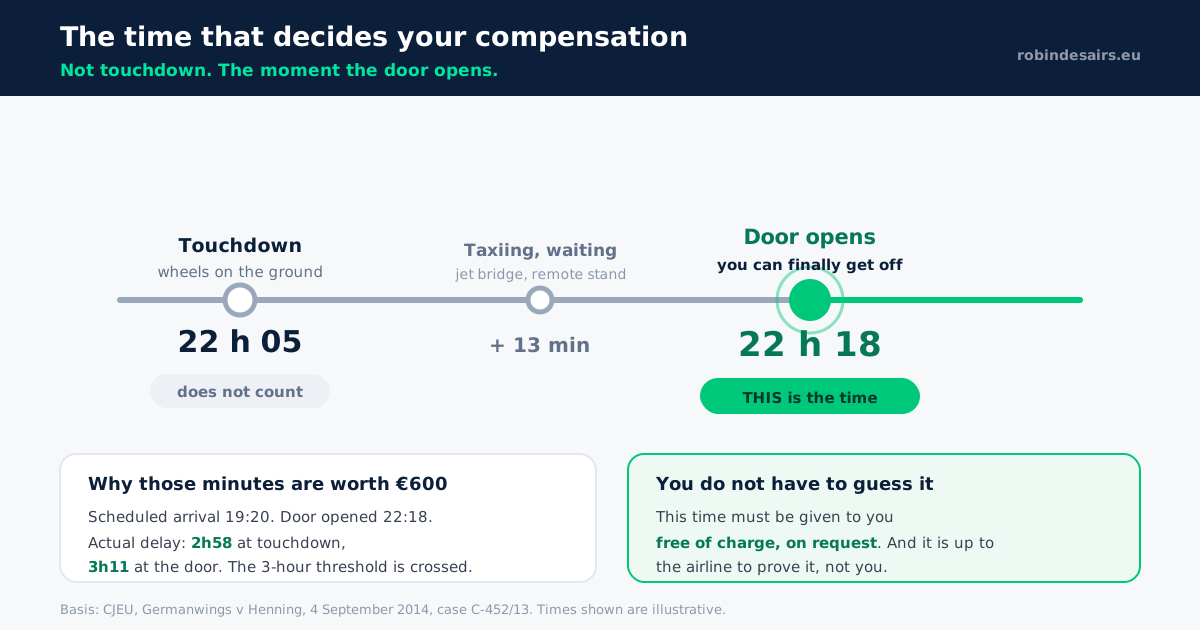
What to actually do. As soon as the door opens and the first passengers step through it, check the time and take a photo. The emptying aisle, the docked jet bridge, the open door: any framing will do. What matters is the timestamp your phone writes into the file automatically. This is exactly what specialist litigation firms do.
Do not confuse it with the thud of the wheels on the runway. That happens far earlier and is worth nothing in law.
And above all, you are not required to guess it. The European Commission's guidelines provide that the actual arrival time must be given to you free of charge, on request. So you can demand it in writing rather than reconstruct it from your seat. It is for the airline to prove the arrival time, not for you: your photo is only a safety net if they stall or quote a fanciful figure.
The airline's own flight status page
There is one piece of evidence almost nobody goes looking for, and it beats all the others: the airline's own flight status page.
Its strength lies in its author. A third-party tracker binds nobody. A weather record is neutral. But a page published by the carrier, on which it writes the arrival time of its own flight, is hard to contradict afterwards: it would have to explain why it was telling the public something else.
Air France calls its tool “Flight status”. It is public, no account needed. You search by flight number, or by route and date. Expand the result and you get the arrival time and the reason for the delay.
That last point is rare. Among the other airlines we examined, none displays a cause. Which is consistent with their interests: the reason determines whether circumstances were extraordinary, and therefore whether they are exempt. Air France is the exception here, and you should use it.
Careful with the time displayed: it works against you
Airlines generally publish the on-blocks time, when the parking brake is set. But the CJEU explicitly ruled that time out, along with touchdown: what counts is the door opening, because until then you are still shut inside the aircraft.
In other words, the time the airline displays understates your real delay. Never give up because the page says 2h50: that is a floor, not a verdict.
Not all airlines are equal
| Airline | Public status tool | History |
|---|---|---|
| Air France | Yes, with the reason | Searchable months back |
| Iberia | Yes | About 7 days |
| Transavia | Yes, with “Departed at” and “Arrived at” | Yesterday and today |
| Brussels Airlines, ITA, Vueling, Ethiopian | Yes | No past flights |
| Kenya Airways, Tunisair | Yes | Same day only |
| Air Senegal | No | Page empty since 2019 |
| Air Algerie | No | No tool at all |
On those last two, a passenger has no official way of documenting their own delay. One more reason to photograph on the spot.
Capture within 72 hours. You have years to claim, but often less than a week to retrieve the proof: most of these pages keep nothing of the past. Capture the airline's page with the address and date visible on screen, saved as a full-page PDF rather than an image.
When the airline must give you a flight delay certificate
Regulation EC 261 requires airlines to inform passengers of their rights in writing, under Article 14. An explicit request from you triggers that obligation. The confirmation should cover:
- the delay and its actual duration
- the cause officially relied on
- the rights that open up: compensation, assistance, rerouting
An airline cannot refuse to certify an objective fact. Your flight was delayed, or it was not.
The request template
Send it by email to customer service or claims, attaching your booking confirmation and boarding pass.
Subject: Request for an official delay confirmation, flight [flight no.] on [date]
Dear Sir or Madam,
I travelled on flight [number] on [date], from [departure airport] to [arrival airport], scheduled to arrive at [time].
That flight was [delayed / cancelled / diverted]. I request that you provide:
- a written statement giving the actual door-opening time at destination, and not the touchdown time
- the official cause of the delay or cancellation
- details of any assistance provided to me
I need this statement in order to [justify an absence from work / trigger my travel insurance / build my EC 261 compensation claim].
Booking reference: [if you have one]
Attached: booking confirmation, boarding pass
Yours faithfully,
[Your details]
Point 1 matters most, and it is the one airlines most readily overlook. Ask explicitly for the door-opening time: a statement mentioning only touchdown works against you.
If the airline does not reply
Reply time: allow about thirty days. Beyond that, chase them.
Format: email, PDF or letter, it makes no difference, as long as the document comes from the claims department.
Refusal: it is challengeable. If the airline refuses or stays silent, move to a formal notice.
- Chase by email after thirty days
- Send a formal notice by recorded delivery
- Escalate to the national enforcement body or the courts
If you were rerouted
When the airline puts you on another flight, also ask for:
- the number, date and time of the replacement flight
- the actual arrival time at your final destination
- proof of care: meals, hotel, transport
The delay is calculated between the originally scheduled arrival time and the actual arrival on the replacement flight. Not between the two flights.
Evidence that does not depend on the airline
If they drag their feet, a claim can still be built without them. Each piece does a different job, and it is combining them that makes a file solid.
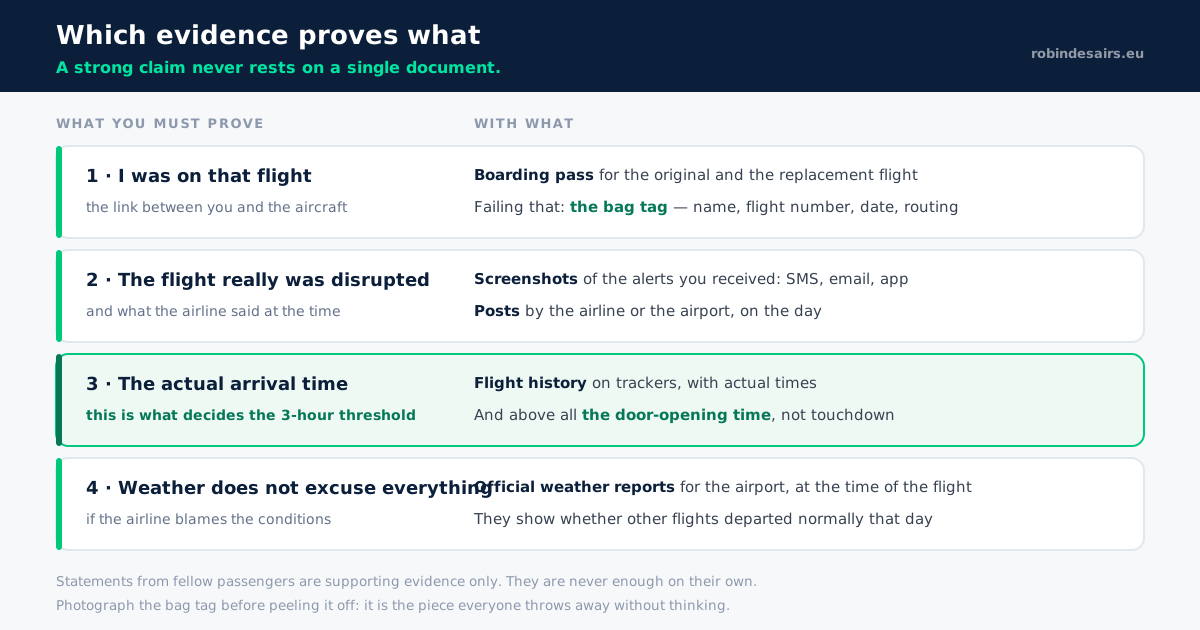
- boarding passes for the original and the replacement flight
- the bag tag, your safety net if the boarding pass is gone
- screenshots of the alerts you received: SMS, email, app
- official posts by the airline or the airport on the day
- flight history on trackers, with actual times
- official weather records, if the airline blames the conditions
- statements from fellow passengers, useful as support but never on their own
Your bag tag: there are three, and you keep the wrong one
When you check a bag in, the agent prints a single adhesive strip that separates into three parts. They are not remotely equivalent, and the result is counter-intuitive.
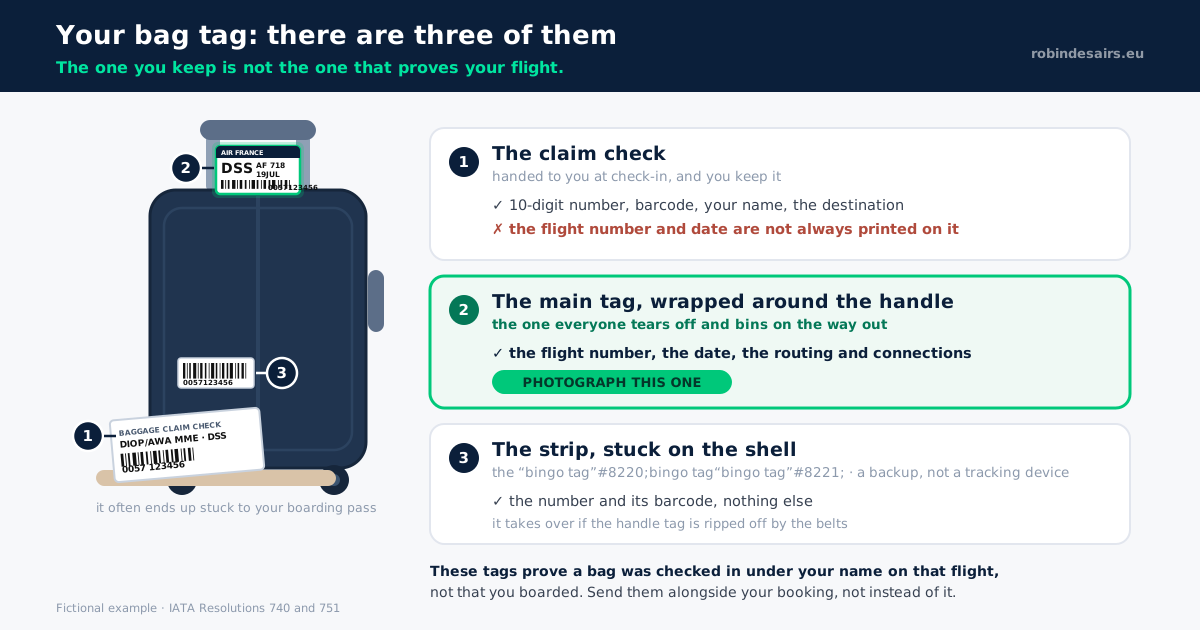
The claim check, handed to you and often stuck to the back of your boarding pass. That is the one you naturally keep. It carries the ten-digit number, your name and the destination. But the flight number and date are not always on it: that depends on the airline.
The main tag wrapped around the handle. By far the richest of the three. It carries your name, the airline code and flight number, the date, and the full routing including connections. It is the one everyone tears off and bins on the way out of the airport.
The thin strip stuck directly on the shell, away from the handle. The trade calls it the bingo tag. It carries only the ten-digit number and its barcode. It is not a tracking device: it is pure redundancy, so the bag stays sortable if the main tag is ripped off by the belts.
So: photograph the main handle tag before you bin it. It is the only one of the three that proves the flight and the date, and it is free evidence you already hold.
That ten-digit number is not an internal reference either: it follows the IATA standard, one digit for the tag type, three identifying the airline, six for the sequence. It is the key linking your bag to every scan recorded during the journey, and it stays usable for weeks after the flight.
One nuance that will save you an argument. These tags prove that a bag was checked in under your name on a given flight. They do not, on their own, prove that you boarded: the pass scanned at the gate does that. So send them alongside your booking, not instead of it.
What Robin des Airs does for you
We send the request ourselves. We cross-check the reply against the flight history, the weather records and the other flights operated that day by the same aircraft. And we build the file without depending on the airline's goodwill.
You do not have to chase your delay confirmation. That is our job.